Commercial Holiday Lighting in Johnson County: A Practical Guide
What commercial holiday lighting costs, when to book it, and how access, timing and takedown work for retail and office property in Johnson County.
Commercial holiday lighting is the same work as residential holiday lighting with three differences: the buildings are longer, the access windows are narrower, and somebody has to approve the spend.
This guide covers the parts that are actually different for a property in Overland Park, Olathe, Lenexa, Leawood or the rest of the Kansas side of the metro.
What it costs
Roofline is $13 per foot, same as residential. There is no commercial surcharge and no per-visit fee.
That makes the math straightforward. Measure the linear footage you want lit and multiply. A single-tenant office with a 200-foot front is $2,600. A strip center front running 400 feet is $5,200. A multi-building office park is priced building by building, and it is common to light only the buildings visible from the street rather than all of them.
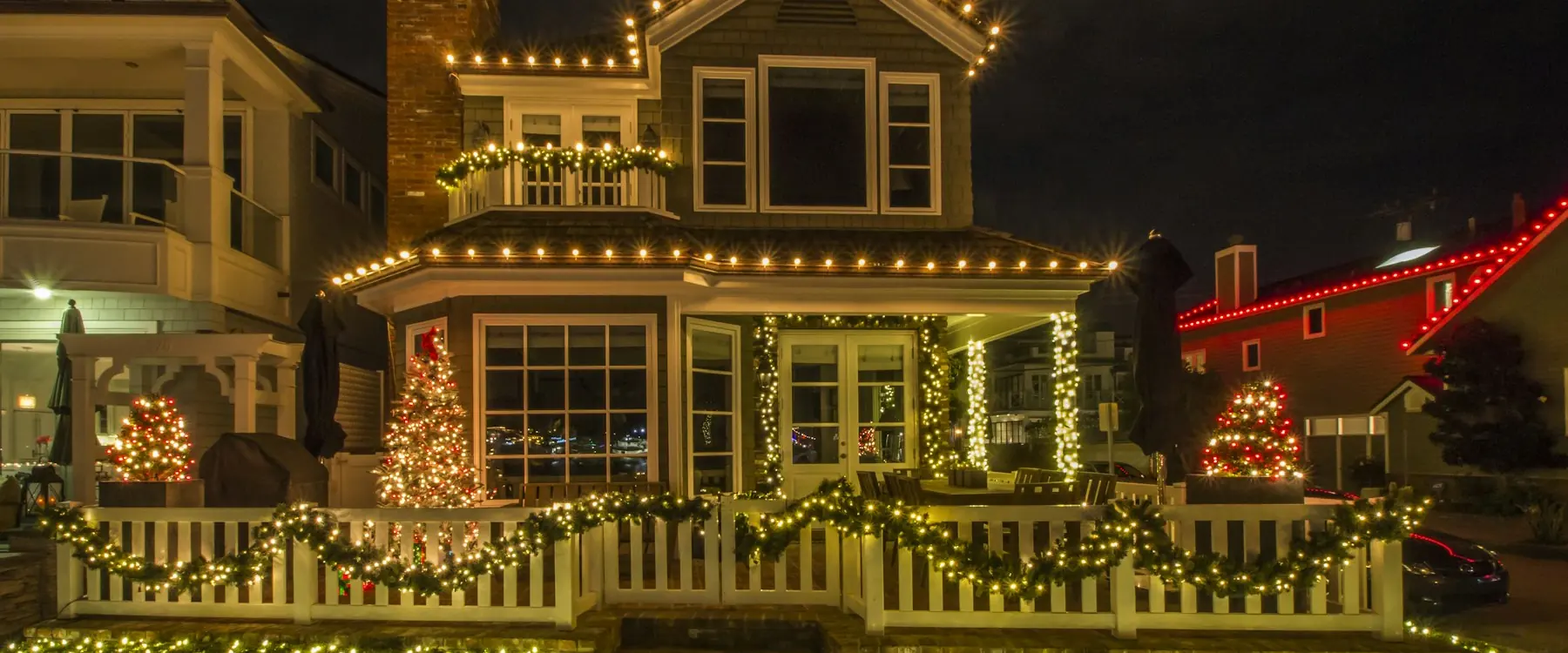
Add-ons are the same list as residential and often matter more on commercial property, because entries and landscaping do more visual work than the roofline does on a low, wide building:
- Wrapped tree: $150 each
- Lit wreath, installed: $125
- Lit garland: $18 per foot
- Path lights: $8 per foot
- Shrub nets: $45 each
- Color or RGB: $2 per foot on top of roofline
For a lot of retail and restaurant properties, the best-looking result is a modest roofline run plus wrapped trees at the entry and garland on the door surround. That reads better from a parking lot than a long unbroken line of roofline does. Full numbers are on the pricing page.
What is included
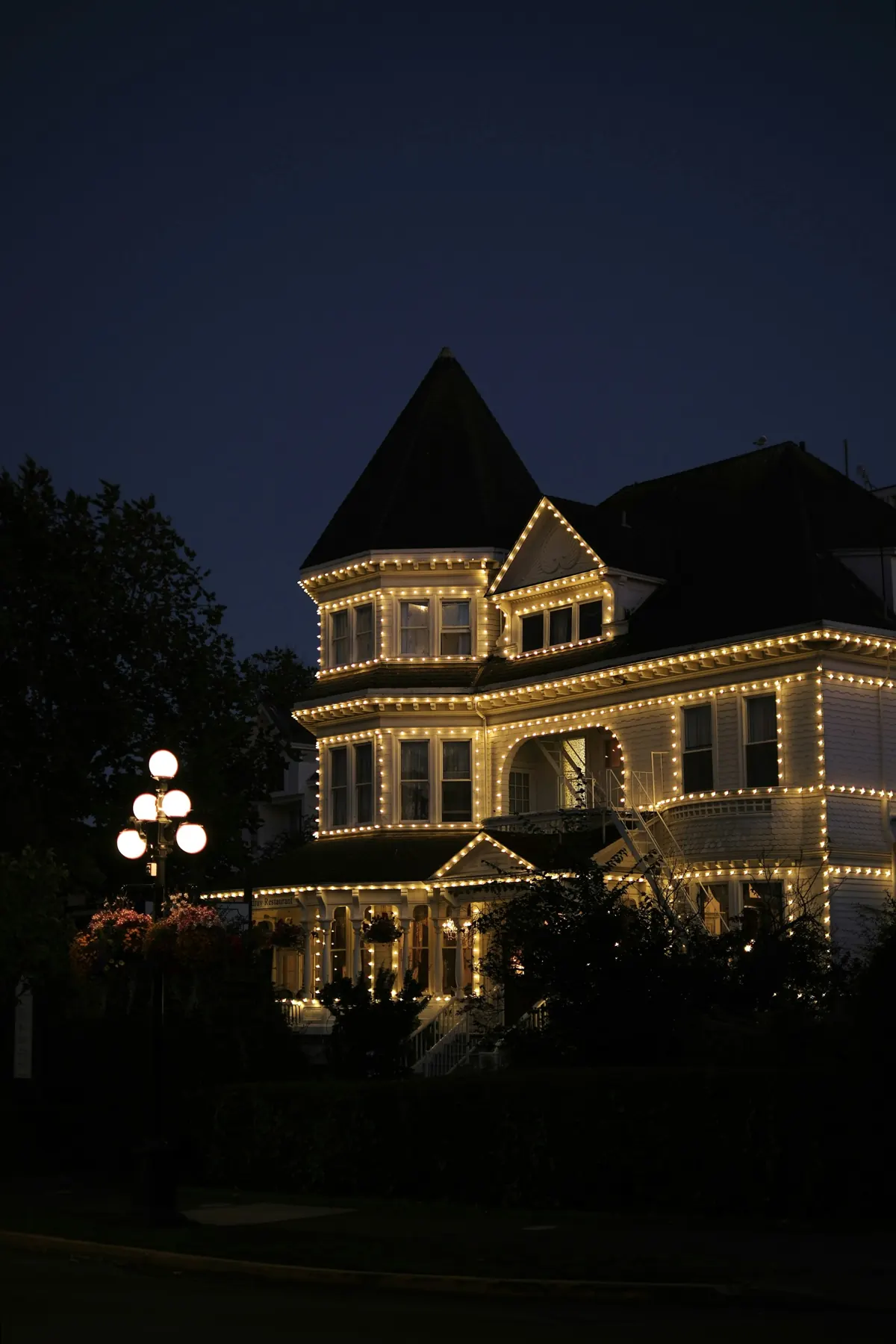
Commercial jobs get the same package as residential. Commercial-grade C9 LED bulbs on cord custom-cut to the building, so there are no coiled excess loops hanging at the corners. Plastic shingle and gutter clips only — never nails, staples or screws, which matters on a property where the owner did not sign up for holes in the fascia. A timer. In-season repairs at no charge. January takedown. Off-season storage, so nothing lives in a maintenance closet for eleven months.
The company owns the lights and stores the cut set, which means year two is a faster install with the same look. For a property manager, that is the practical benefit: you approve it once, and the following year it is a scheduling conversation instead of a design conversation.
Timing, and why October is not early
Installs run October through mid-December. Turn-on is whatever date you pick, most often the day after Thanksgiving, controlled by the timer.
The reason to book early on commercial work is not scarcity messaging. It is that three real constraints stack up.
First, the schedule. Every installer in Johnson County is booked solid the week before and the week after Thanksgiving. That is when residential demand peaks and it is also when most retail properties want to be lit. Work booked in October lands where you want it. Work booked in mid-November lands where there is room.
Second, approvals. Commercial spend usually goes through an owner, an asset manager, or a board, and that adds two to four weeks that have nothing to do with lighting. Starting the quote in September means the approval clock runs during a period when the install schedule is still open.
Third, weather. Kansas City delivers early cold snaps. A hard freeze in the first week of November is not unusual, and neither is an ice event before Thanksgiving. Crews do not put people on a wet or icy commercial roof, so a week of bad weather pushes everything behind it. Building in slack is the only real defense. More on the seasonal calendar in when to hang Christmas lights in Kansas City.
Access is the part people forget
On a house, access is a driveway and a ladder. On commercial property, access is a scheduling problem.
Parking lot work over occupied spaces needs a low-traffic window — early morning before a retail center opens, or a Sunday for an office park. Restaurants have a narrow gap between lunch and dinner prep. Medical and senior living properties have patient and resident traffic that is not negotiable. Anything above a public sidewalk needs the walkway managed while crews are overhead.
None of this is difficult, but it has to be decided before the crew shows up, not when they arrive. The useful information to send with your address is: what hours the property is quiet, whether there is roof access from inside, where a truck can stage, and who to call if a door needs to be unlocked.
Tenant coordination in a multi-tenant building is worth doing in advance too. If four of six storefronts want their entries lit and two do not, that is a fine outcome — but it needs to be settled before the cut, because cord is cut to the run.
Consistency across a portfolio
If you manage several properties, the thing worth deciding once is the look. Warm white C9 across every building reads as a single portfolio. Multicolor at one property and warm white at another reads as two different vendors.
Warm white is also the safer choice for tenant-facing property because it reads as winter rather than as one specific holiday, which is why most commercial requests come in as "holiday lighting" rather than "Christmas lighting." Those are the same service — we go into it in holiday vs Christmas light installation — but the word choice usually signals that the property wants something broad. Blue and white is the common alternative. RGB at $2 per foot exists if a brand needs a specific color, though it is a bigger commitment visually than most properties want.
Repairs during the season
This is where the commercial and residential cases genuinely diverge. On a house, a dark six-foot section is annoying. On a storefront, it is visible to everyone who walks past for however long it takes to fix.
In-season repairs are included at no charge, and the practical reason that matters is response, not cost. A single bad connection after an ice storm should not require a purchase order. If you notice a dark section, it gets fixed. See repair service for how that works.
Takedown
January, included. Crews come back, remove every clip, and take the set to storage.
Removing every clip matters more on commercial roofs than residential ones, because the roof surface on a low-slope commercial building is a different system than asphalt shingle and leftover hardware is a maintenance issue somebody inherits in June. We cover the general takedown process in takedown and storage.
Get a price
Send the property address at /#quote — along with the quiet hours and any tenant notes if you have them. We measure the roofline from satellite imagery and text a price within 24 hours. No sales visit, no walkthrough, and if you manage several buildings, send them all at once and you will get the set priced together. More on commercial scope at /commercial-christmas-lights.