How to Measure Your Roofline for Christmas Lights
Measure your roofline for Christmas lights from the ground in about 20 minutes. Here is the method, the pitch correction, and the mistakes that skew totals.
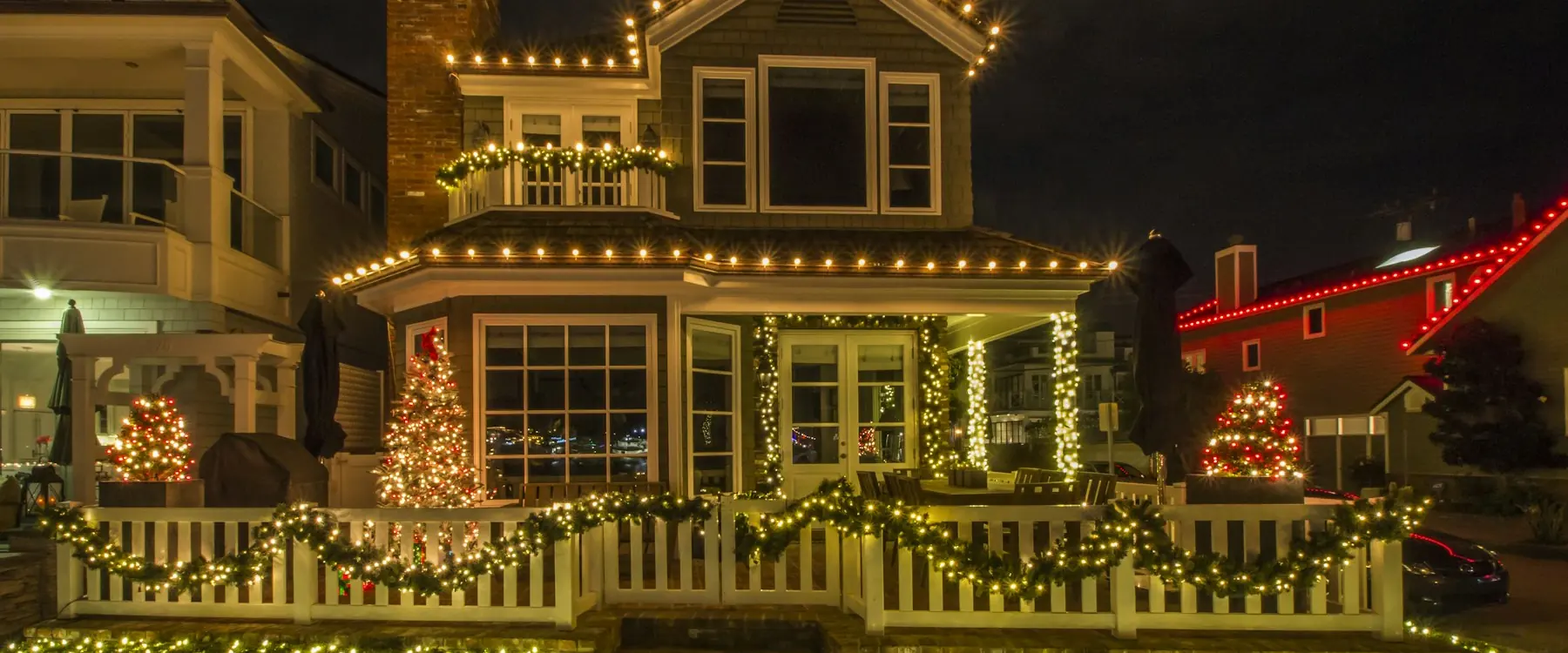
You do not need to get on a ladder to measure a roofline. Nearly all of it can be done from the ground with a tape measure and about twenty minutes.
This matters because roofline length is what drives the price. At $13 per foot, knowing whether your house is 160 feet or 240 feet is the difference between a $2,080 estimate and a $3,120 one. It also tells you how much cord to buy if you are doing it yourself.
First, decide what you are lighting
Measure the edges you want lit, not every edge on the building. This is the step people skip, and it is the one that changes the number most.
Most homeowners light the front elevation only — the gutter runs and gables facing the street. Some add a return down one side to the point where it stops being visible from the curb. Very few light the back, and there is usually no reason to.
Walk to the sidewalk and look at your house the way a driver does. The edges that read from there are the edges worth paying for. A gutter run behind a mature tree contributes nothing. A short segment tucked behind a garage projection contributes nothing. Cut those before you measure.
Measure the horizontal runs from the ground
Every horizontal gutter line has a matching length on the ground directly beneath it. That is the measurement you want, and gravity makes it easy.
Take a 100-foot tape, or a measuring wheel if you have one. Start at one corner of the house and walk the drip line, following the wall below each gutter run. Write down each segment separately rather than trying to keep a running total in your head — a house with a bump-out for the garage and a recessed entry might have five or six distinct front segments.
Do not cut corners around the porch. If the gutter runs across the front of a covered porch, that length counts, even though the porch roof is lower than the main roof.
Ground measurement is accurate for horizontal runs because the gutter is directly above the wall. Where it stops being accurate is overhangs, and only slightly — a typical eave overhangs the wall by a foot or two on each end, so add a couple of feet per run if you want to be precise.
Add the sloped sections
Gables, rakes and dormer edges are the part people get wrong, and they get it wrong in the same direction every time: too short.
A sloped edge is longer than the horizontal distance it covers. Measure the horizontal span of the gable at ground level — from one bottom corner of the triangle to the other — then add for pitch.
Rough correction factors for common residential pitches:
- A shallow roof, around 4/12, adds about 5 percent to the horizontal span.
- A typical suburban pitch, 6/12 to 8/12, adds roughly 12 to 20 percent.
- A steep roof, 10/12 or more, adds 30 percent or more.
Most Johnson County housing sits in the middle band. If you do not know your pitch and do not want to work it out, adding 20 percent to sloped spans is a safe default that rarely overshoots by much.
One caution: a gable has two sloped edges, not one. A triangle over the garage with a 20-foot base is two runs of roughly 12 feet each, not one run of 20. That single mistake accounts for most of the underestimates people bring to a quote.
Using satellite imagery instead
If you would rather not walk the yard, satellite view works for the horizontal portion.
Open your address in a mapping tool, switch to satellite, and use the measure-distance function to trace each gutter run. Overhead imagery is good at horizontal distance and useless at slope — a gable edge viewed from directly above appears as its horizontal span, so you still have to add the pitch correction by hand.
Two things to watch. Tree cover in older neighborhoods can hide entire runs, particularly in Prairie Village and the older parts of Mission, so cross-check anything obscured against a photo from the street. And imagery goes stale — if you have added a covered patio or a room in the last few years, the picture may not show it.
This is the same method used for quoting here, which is why no sales visit is needed. Send an address, the roofline gets measured, and a price comes back by text within 24 hours. The full process is on how it works.
Sanity-check your total
Once you have a number, compare it against typical ranges for this metro.
Single-story fronts usually land between 100 and 180 feet. Two-story homes with peaks and dormers usually land between 180 and 280 feet.
If your ranch came out at 320 feet, you probably included the back of the house or double-counted a segment. If your two-story with three gables came out at 120 feet, you probably measured gable bases instead of gable edges, or skipped a run.
Multiply by $13 to get the roofline price. Then add whatever you want around it — a wrapped tree at $150, a lit wreath at $125 installed, garland at $18 per foot for columns and the entry, path lights at $8 per foot, shrub nets at $45 each. Color or RGB on the roofline is $2 per foot on top. All of it is on pricing.
What this measurement does not tell you
Length is the price, but it is not the whole job.
It says nothing about access — whether a run can be reached from a ladder or needs work off the roof itself, and how steep that roof is. It says nothing about where power comes from, which matters more than people expect on older homes with one exterior outlet on the wrong side of the porch. And it says nothing about the small decisions that make an install look intentional: where a run terminates, how a peak is handled, whether a dormer gets traced or skipped.
Those are worked out on install day. But the number in your hand from twenty minutes with a tape measure will be close, and it lets you have a real conversation about cost before anyone climbs anything. If you are weighing doing it yourself, DIY versus professional has the rest of the comparison.
Get a price
You do not have to measure anything. Send your address and the roofline gets measured from satellite imagery, with a price by text within 24 hours and no visit. Send your address and compare it against your own number.