Permanent Track Lighting vs Seasonal Christmas Lights
Permanent RGB track costs far more up front and stays on the house all year. Seasonal C9 is the traditional look with no year-round hardware. The real case for each.
Permanent lighting is a real product with real advantages, and if a company tells you otherwise they are selling against it rather than explaining it. We install seasonal C9. Here is the fair version of both sides anyway, because the right answer genuinely depends on what you want the house to do the other eleven months of the year.
What each one actually is
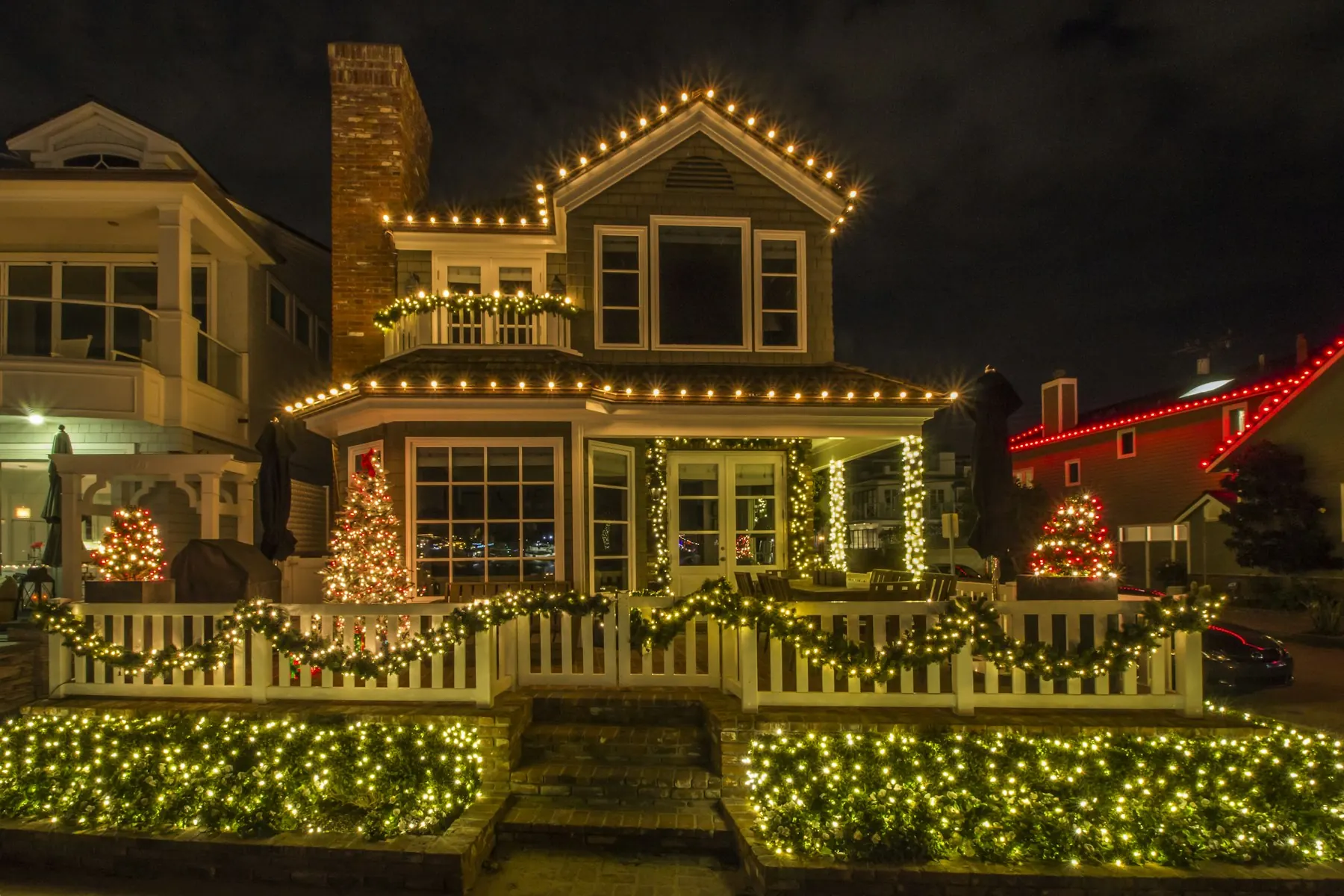
Seasonal C9. Commercial-grade C9 LED bulbs on a cord cut to your roofline, held by plastic shingle and gutter clips. It goes up in the fall, runs on a timer, comes down in January, and lives in storage until next year. The house looks like a house from February to October. This is the traditional look — the big bulbs with visible spacing along the roof edge.
Permanent track. A low-profile aluminum channel mounted to the fascia or roof edge, holding individually addressable RGB LEDs. It is installed once and stays. It is controlled from an app, changes color, runs patterns, and can do warm white for Christmas, orange for Halloween, red white and blue in July, or team colors in the fall.
They are not the same product competing on price. They are two different decisions.
The honest case for permanent
If you will use it year-round, the value proposition works.
Once it is up, there is no annual scheduling, no crew on your roof, and no window where you missed the install and the neighborhood is lit and you are not. You control it from your phone. You can change color for an event, dim it, or run soft accent lighting on an ordinary Tuesday in April, which is a genuinely nice thing that seasonal lighting cannot do at all.
The per-year cost also crosses over eventually. Pay once, use it for years. Whether that crossover arrives in year four or year eight depends entirely on the quote, and quotes vary a lot, so run the arithmetic with real numbers rather than a rule of thumb. Divide the installed cost by the number of years you expect to be in the house and compare that to an annual seasonal price. If you plan to move in three years, the math almost never works. If this is the house you retire in, it might.
There is one more advantage that gets undersold: nobody climbs your roof every November and January. Fewer ladder trips is fewer chances for something to go wrong.
The honest case against permanent
Cost up front is the obvious one. Installed permanent RGB track typically runs several times what a seasonal install costs for the same footage, because you are buying the channel, the diodes, the controller and usually some electrical work outright rather than renting a service. That is a capital decision, not a seasonal one.
It is on your house all year. Manufacturers have gotten good at low-profile channel painted to match trim, and on a lot of houses it genuinely disappears from the curb. On others — dark channel against white trim, or a deep shadow line under the eave — it is visible up close in daylight. This is not something to take on faith from a rendering. Go look at an installed system on a house with your trim color, in daylight, from the sidewalk.
The look is different at night too, and different is the accurate word rather than worse. Track LEDs are a continuous line of small point sources. C9 is spaced individual bulbs with visible gaps and a warmer, softer glow. Some people want the clean modern line. Some people want the bulbs their grandparents had. Neither is wrong, but if the traditional look is what you are after, permanent track will not give it to you no matter what color you set it to. The bulb question is worth reading about separately in C9 vs mini lights.
Then there is the ownership tail. It is your hardware. Controllers fail, individual diodes go out, and warranty terms vary widely between manufacturers and installers. Ask specifically who fixes it in year six and what that costs. On a seasonal service, repairs during the season are included and the company owns the equipment, so a failure is their problem to solve.
Finally, removal is not simple. Taking a track system off means pulling the channel, dealing with fastener holes in the fascia, and handling whatever electrical was added. That is worth knowing before you commit.
The honest case for seasonal
Lower up-front cost, and no year-round hardware. Roofline is $13 per foot, which puts a typical Johnson County single-story front at 100 to 180 feet — $1,300 to $2,340 — and a two-story with peaks at 180 to 280 feet, or $2,340 to $3,640. Details on the pricing page.
That price includes the things people forget to compare. Commercial-grade C9 LED bulbs on cord custom-cut to your roof. Plastic clips only, never nails, staples or screws. A timer. In-season repairs at no charge. January takedown. Off-season storage, so nothing takes up garage space. The company owns the lights, and the same cut set goes back up next year.
It also stays flexible. If you add a wrapped tree at $150 or garland at $18 a foot next season, or you decide to light the side of the house you skipped, that is a conversation, not a re-install of mounted hardware. And if you sell the house, you are not leaving a system behind or explaining it to a buyer.
The trade-off is real and worth stating plainly: it is a recurring cost, it happens on someone else's schedule, and there is a crew on your roof twice a year.
Where Kansas weather comes into it
Both systems handle Kansas City winters. But the failure modes differ.
Seasonal C9 lives outside for roughly two and a half months. Permanent track lives outside through 100-degree July afternoons, hail, and the freeze-thaw cycling that makes our winters hard on anything mounted to a roof edge. Good systems are built for that. Ask specifically about hail coverage and about how the channel is fastened, because a channel screwed into fascia is a row of penetrations at the wettest edge of your house — the same reason we do not use staples or nails on seasonal installs.
On the seasonal side, the weather constraint is scheduling. Early cold snaps and pre-Thanksgiving ice compress an already tight install window, which is why our season starts in October rather than the week everyone wants lights on.
A simple way to decide
Ask one question: will you turn these on in June?
If yes — you want color for Halloween, the Fourth of July, birthdays, game days — permanent is probably worth the money, because you are buying eleven months of use, not one. Get a written per-foot quote, look at a daylight example, and ask who services it in year six.
If no — you want warm white on the roofline from Thanksgiving to January and nothing on the house the rest of the year — seasonal C9 gives you exactly that at a fraction of the up-front cost, and somebody else stores it. Add RGB color to a seasonal install for $2 per foot if you want the option without the hardware.
Either way, look at how it works and at a few installed houses in Overland Park or Leawood at night before you decide. Photos flatten the difference between these two looks more than you would expect.
Get a price
If seasonal is the direction, send your address at /#quote. We measure your roofline from satellite imagery and text a price within 24 hours. No sales visit. If you are still weighing permanent, get that quote too and compare the real numbers side by side.