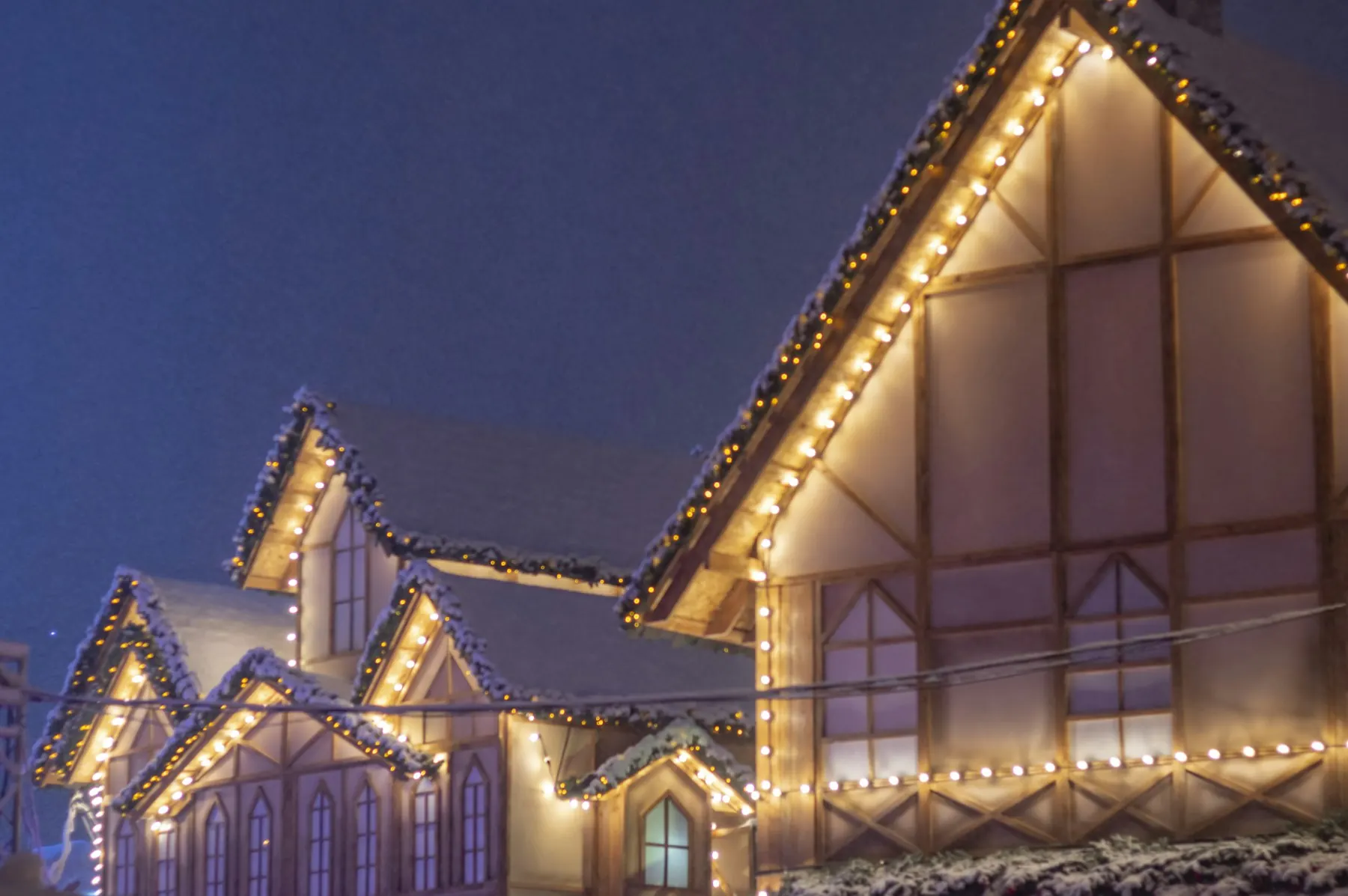
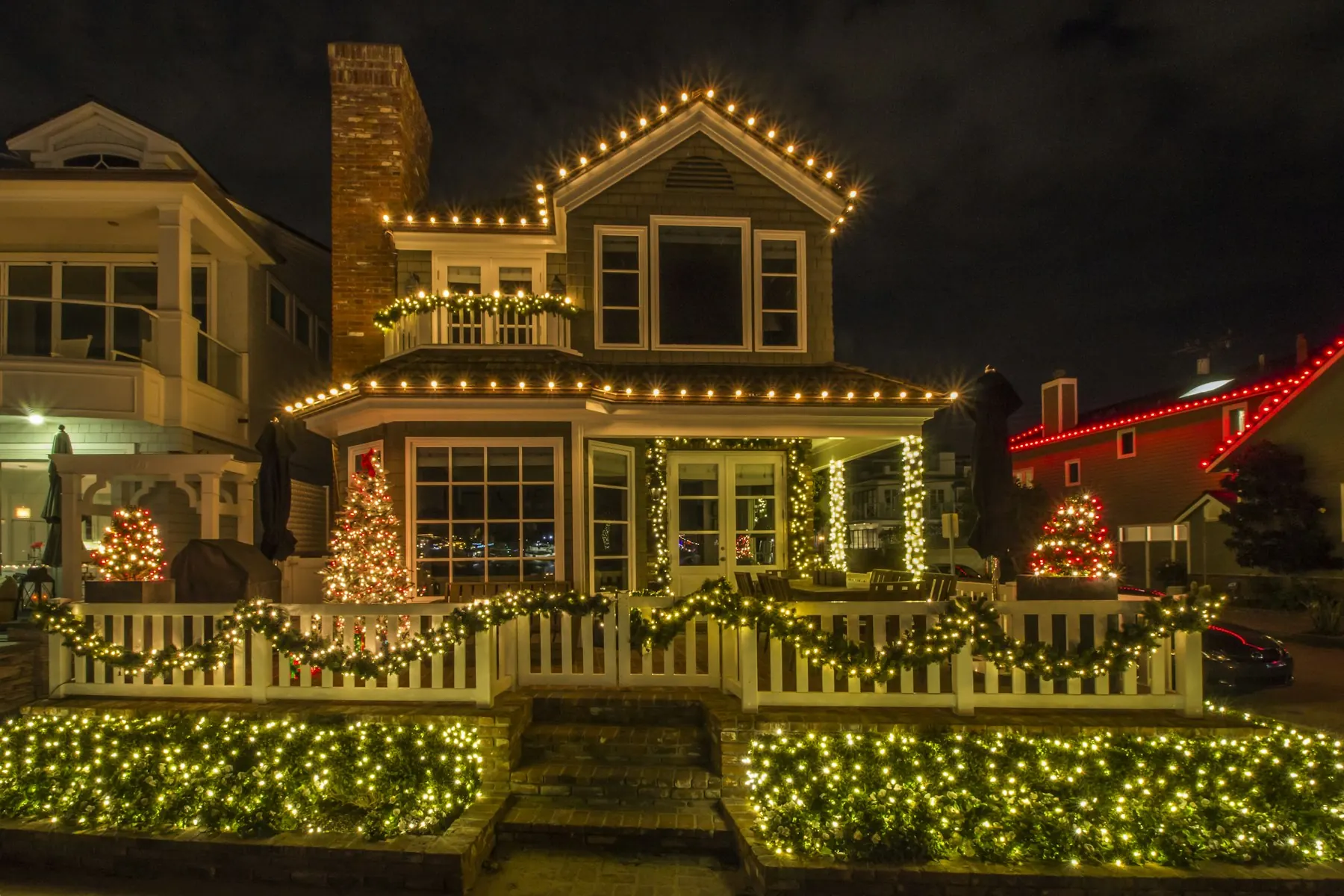
C9 vs Mini Lights for a Roofline: Which Looks Better From the Street?
C9 bulbs read cleanly from the curb; mini lights disappear past 40 feet. Here is the honest comparison for a Kansas City roofline, spacing and all.
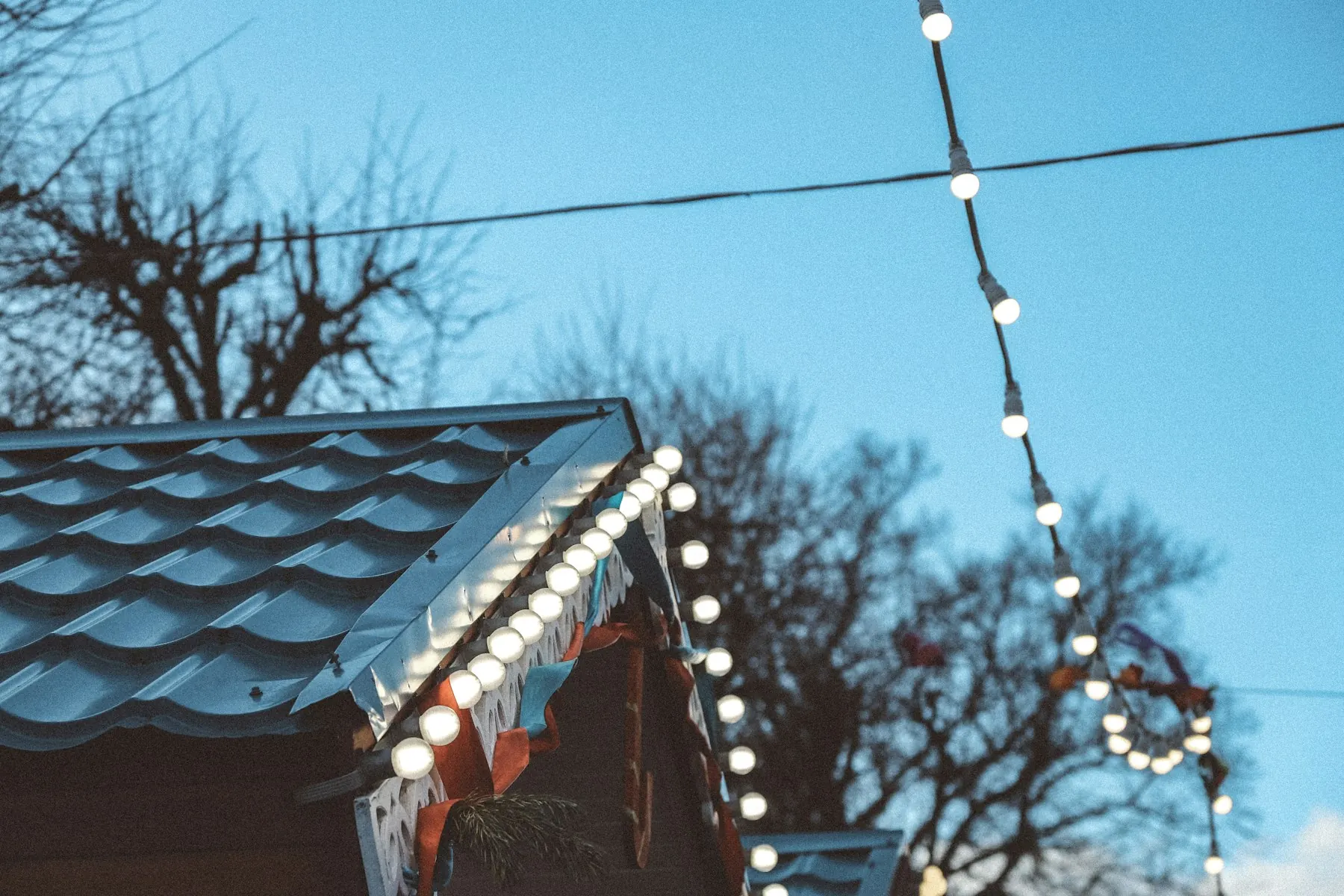
For a roofline seen from the street, C9 bulbs win. It is not close.
Mini lights are not a bad product. They are the wrong product for a roof edge. The difference comes down to one thing — how far away the viewer is standing — and once you understand that, the choice makes itself.
The distance problem
A mini light is roughly the size of a pea. On a tree you are walking past, that is charming. On a gutter line 25 feet up and 60 feet back from the sidewalk, it is a smudge.
Point sources of light need to be big enough to resolve as points at viewing distance. A C9 bulb is about two and a half inches tall and puts out a visible glowing body, not just a filament. From across the street, you see individual bulbs marching along the roof edge. From a car driving by, the same thing. The line stays crisp.
Minis at the same distance blur into an ambiguous glowing string. Some people like that. But it is a different effect, and it is the effect you get by accident rather than by choice.
If you have ever driven a Johnson County neighborhood in December and thought "that house looks sharp and that one looks fuzzy," the sharp one was almost certainly on C9s.
Spacing, and why it matters more than brightness
C9s on a professional roofline install sit about twelve inches apart. That spacing is what creates the rhythm — a repeating pattern your eye reads as intentional.
Mini lights are typically spaced two to four inches apart. On a straight run that reads as a continuous line. On a peak or a rake, the density hides the geometry of the roof instead of tracing it, which defeats the point. The whole reason to light a roofline is to draw the shape of the house.
There is a second spacing issue. Mini strings come in fixed lengths — 50 or 100 bulbs — so on a real roof you are joining strings mid-run, and the joints land wherever they land. C9s on custom-cut cord get a socket exactly where a bulb should go, and the cord ends exactly where the roofline ends. That is the difference between a set built for your house and a set that happens to fit.
Peak Season Lighting cuts the cord to the measured roofline, which is why the company owns the lights rather than selling them to you. The same set goes back up next year. More on how that works on roofline lighting.
Durability in a Kansas winter
This is where minis really struggle outdoors.
Mini strings run bulbs in series in sections. Pull one bulb loose and a whole segment goes dark. Wind, ice load and freeze-thaw all work bulbs loose over a season, and a Kansas City December supplies all three. The failure mode is a dark stretch in the middle of a run, usually somewhere you need a ladder to reach.
C9 bulbs thread into individual sockets on a parallel cord. One bulb failing takes out one bulb. You lose a point of light, not a section of roofline, and from the street it is barely noticeable until someone gets to it.
The cord matters too. Commercial-grade C9 cord is heavier gauge with molded sockets built to sit outside for three months. Retail mini strings are built to a price point for indoor and light outdoor use. Both will survive a mild season. Only one reliably survives an ice event.
In-season repairs are included in the per-foot price here, which changes the calculation somewhat — you are not the one climbing up in December either way. Details on Christmas light repair.
Power draw
LED C9 bulbs draw roughly a watt or less apiece. Older incandescent C9s drew somewhere around seven watts each, which is why long incandescent runs used to trip breakers and why people remember C9s as power-hungry. That is no longer true.
A 200-foot roofline at twelve-inch spacing is about 200 bulbs. At roughly a watt each, that is on the order of 200 watts running for maybe six hours a night on a timer. Over a full season that lands in the range of a few dollars of electricity. Mini LEDs draw less per bulb but you use far more of them, so the totals are closer than you would guess.
Neither option is going to show up meaningfully on an Evergy bill. We break the numbers down further in timers and electricity cost.
Where minis genuinely win
Being fair about this matters, because there is a real answer.
- Wrapped trees and columns. Density is the goal. You are looking at the object from ten feet, not sixty, and minis give you a continuous glow around a trunk that C9s cannot.
- Shrubs and hedges. Net lights and minis fill volume. C9s on a shrub look like a handful of scattered bulbs.
- Railings, porch garland and close-up detail. Anything the viewer stands next to.
That is exactly how a well-lit house is usually built here: C9s on the roofline for the architecture, minis and net lights below for the landscape. It is not one or the other. It is the right bulb at the right distance. Tree wrapping runs $150 per tree and shrub nets are $45 each — see tree wrapping.
Warm white, cool white, or color
One more variable worth naming, since it interacts with bulb choice.
Most Johnson County housing stock is brick, stone or painted siding in warm tones. Warm white C9s sit well against that. Cool white reads blue-ish against red brick and can look clinical rather than festive.
Color and RGB on a roofline is an add-on at $2 per foot. On a 250-foot house that is $500, which is a real decision rather than a small one. Color tends to work better in short runs, on trees and around entries than along an entire roof edge. That is a taste call, not a rule, but it is the pattern that holds up over time.
The practical summary
If someone is going to see the light from the curb, use C9. If someone is going to see it from arm's length, minis are fine and often better. A roofline is a curb-distance element by definition.
Pricing for roofline work is $13 per foot flat, which includes the C9 LED bulbs on custom-cut cord, plastic clips, the timer, repairs, January takedown and storage. The full breakdown is on pricing.
Get a price
Send your address and the roofline gets measured from satellite imagery, with a price back by text within 24 hours. Send your address and you can decide on bulbs after you see the number.