DIY vs Professional Christmas Lights: An Honest Comparison
DIY Christmas lights cost less in year one and more of your time every year after. Here is a straight comparison for a Kansas City roofline.
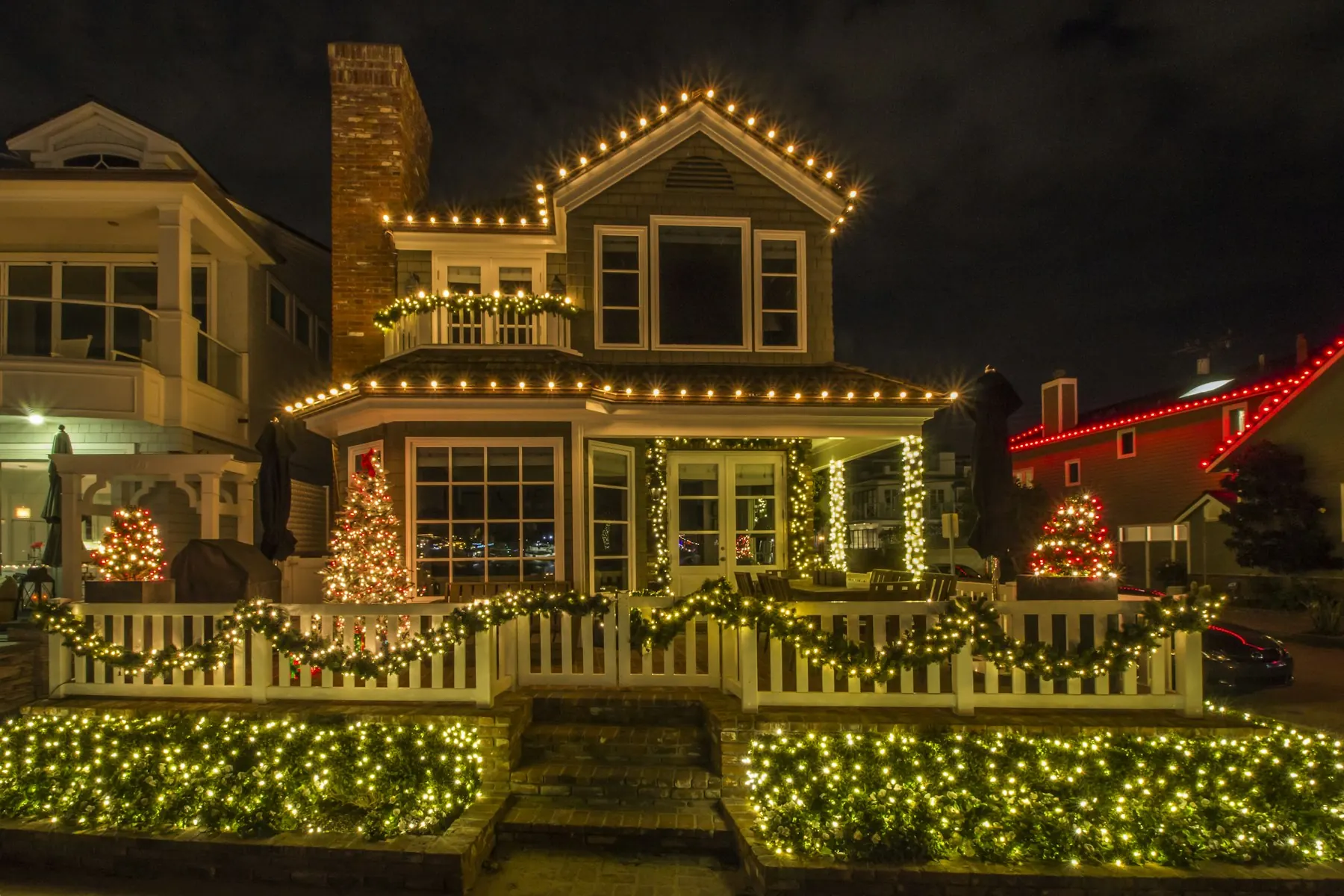
DIY Christmas lights are a legitimate choice. Plenty of people in Johnson County do it well and enjoy doing it. This is not a page arguing that you cannot.
It is a page laying out what each option actually costs — in money, in hours, and in risk — so you can pick with the real numbers in front of you.
The first-year money comparison
Professional roofline installation here is $13 per foot. A 200-foot house is $2,600. That covers commercial-grade C9 LED bulbs on custom-cut cord, plastic clips, a timer, in-season repairs, January takedown and off-season storage.
DIY on the same 200 feet, done properly, looks roughly like this. Commercial-grade C9 LED cord and bulbs typically run somewhere in the range of one to two dollars per foot depending on quality and where you buy. Clips are cheap — a few cents each, and you need one per foot or so. A timer is under thirty dollars. Extension cords and a spare bulb pack add a bit more. Call it a few hundred dollars for the set, plus whatever ladder you need if you do not already own a good one.
So year one, DIY is meaningfully cheaper on materials. That is true and worth saying plainly.
The variable people underestimate is quality of components. Big-box seasonal C9 sets are not the same product as commercial cord with molded sockets. The cheap version works fine in a mild season and starts failing after one or two Kansas winters. If you buy the good stuff up front, your DIY materials cost goes up and the durability gap closes.
The time comparison
This is where the honest accounting gets uncomfortable.
A first roofline install on a two-story house is a full day. Realistically, for most people, it is a weekend. You are measuring, laying out runs on the driveway, testing every string on the ground, figuring out where the outlet is and how to get power there without a cord across the walkway, and then doing the clipping — which is the fast part.
The second year is faster because you know the layout. Call it half a day if the set survived storage intact.
Then there is takedown. Nobody plans for takedown. Add another half day in January, on a day that is almost certainly colder and windier than the day you put them up. And add the hour you will spend in October of the following year untangling what went into the tub.
If your time is worth something and you have a two-story roof, the labor gap is a few hundred dollars a year even at a modest hourly value. If you genuinely enjoy the work — and some people do — that math does not apply, because you are not spending time, you are spending a Saturday you wanted to spend that way.
The risk comparison
Ladder work in November is the real difference, and it deserves a direct paragraph rather than a scare paragraph.
Falls from ladders and roofs are a leading cause of serious home-maintenance injury, and holiday lighting concentrates that work into the coldest, shortest-daylight weeks of the year. In Kansas City that means frost on shingles in the morning, wind that comes up in the afternoon, and a roof surface that behaves differently at 30 degrees than it did in October.
The specific things that go wrong are predictable. Setting a ladder on soft or uneven ground. Reaching sideways instead of moving the ladder. Going up carrying a string in one hand. Getting on a steep second-story pitch to reach a gable that could have been done from the ladder with a pole. Working past the point where your hands are cold enough to affect grip.
None of that means do not do it. It means if you do it, do it in daylight, in October, with someone else at the base of the ladder, and stay off pitches you are not comfortable on. A gable you cannot reach safely is a gable you leave dark. That is a completely acceptable outcome.
Roof damage, which is the quieter risk
Staples and nails are the most common DIY shortcut and the most expensive one.
A staple through a shingle or into a fascia board is a hole. Water finds holes. In a metro with real freeze-thaw cycling, that hole gets bigger every year. The damage does not show up in December — it shows up as a stain on a bedroom ceiling three winters later, and it is not covered by anything.
Plastic shingle and gutter clips solve this completely. They cost pennies, they slide under the shingle edge or over the gutter lip, and they leave nothing behind. There is no situation where a staple gun is the correct tool for holiday lights. We never use nails, staples or screws, and neither should you. The longer version is in clips versus staples.
What you are actually buying professionally
Beyond the install itself, three things.
First, you do not own the lights. The set is cut to your roofline, and it is the company's inventory. When something fails in December, that is a repair visit at no charge rather than a trip to the store and a ladder. Nothing goes in your garage.
Second, takedown is handled. January, included, off your list.
Third, the second year is a phone call. The measurement already exists, the custom-cut set already exists, and it goes back on the same house. The details are on how it works and takedown and storage.
A fair way to decide
- Single story, simple roofline, you own a good ladder, you like the project. DIY is a reasonable call and probably the better value.
- Two story, steep pitch, multiple gables, or you are over the ladder. Professional install is worth what it costs, and the difference is mostly not about money.
- You did it yourself for three years and the tub is a mess. That is the most common reason people call the first time.
Nobody needs to be talked into this. The prices are public — $13 per foot, typical fronts of 100 to 180 feet single-story and 180 to 280 feet two-story — and they are on pricing so you can compare them against a materials receipt yourself.
If you want to price it out for your house before deciding, how to measure your roofline shows the method. Service is Kansas side of the metro only — Overland Park, Leawood, Prairie Village, Olathe, Lenexa, Shawnee and Mission among others.
Get a price
Send your address and you will get a measured price by text within 24 hours, with no visit and no follow-up calls if you decide to do it yourself. Send your address if you want the number to compare against.