Christmas Light Clips vs Staples: What Actually Damages Your Roof
Staples and nails put holes in shingles and gutters. Plastic clips do not. Here is how each attachment method fails on a Kansas roof, and what to use instead.
Most roof damage from Christmas lights does not happen in December. It shows up the following spring, as a stain on a bedroom ceiling or a soft spot in fascia board, and nobody connects it to the string of lights that went up two Novembers ago.
The cause is almost always the same. Something sharp went into the roof to hold a light up.
The three ways people attach lights
There are really only a few options, and they are not equal.
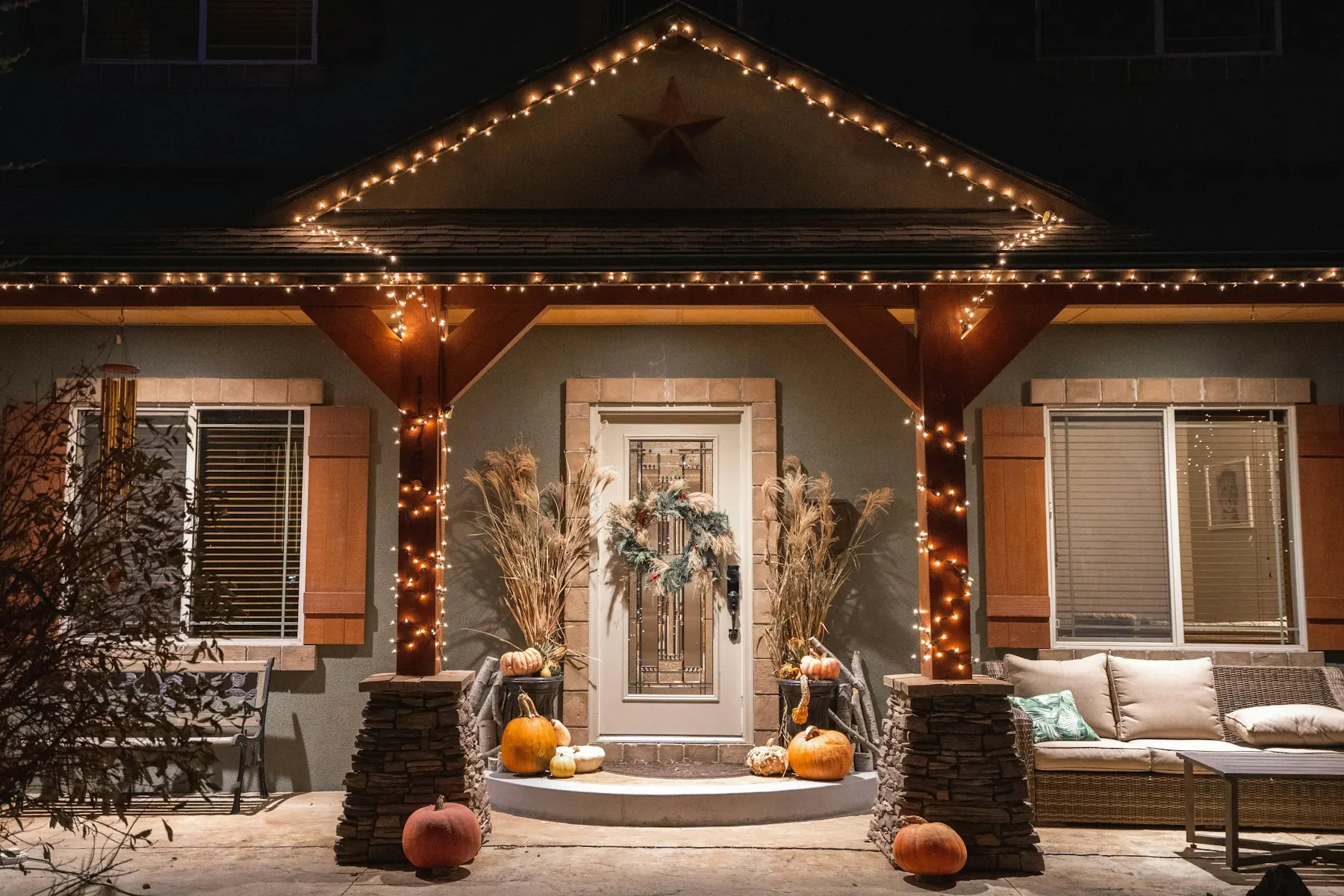
Plastic clips. Purpose-made clips that slide under a shingle's front lip, over a gutter edge, or onto a gutter lip, and hold the bulb socket or cord by tension. No fastener enters the roof. This is what we use on every install.
Staples and nails. A staple gun or insulated staples driven into fascia, trim, or the shingle itself. Fast, cheap, and permanent in the worst sense.
Adhesives. Hot glue, outdoor mounting tape, adhesive hooks. Popular on brick and stone where clips have nothing to grab.
Why staples are the real problem
A staple is a hole. Two holes, technically. Driven into a shingle, it goes through the mat and the granule layer that keeps water out. Driven into fascia or trim, it breaks the paint film that keeps the wood dry.
One hole is not a leak. That is why the damage takes years to appear and why so many people staple lights up every season and swear it is fine. It is fine, until it is not. Water gets into the hole, freezes, expands, opens the hole slightly wider, thaws, and gets in a little further. Kansas City gives you that cycle a lot. We swing above and below freezing repeatedly from December through February, sometimes twice in a day. That freeze-thaw cycling is harder on a small penetration than a straight deep freeze would be.
Then there is the removal problem. Nobody pulls every staple in January. They cut the string, leave the staples, and staple new lights next to them next fall. After five seasons a fascia board has a hundred rusting steel points in it, and the rust stains bleed down white trim in the first spring rain.
Nails are worse in one specific way. They are usually bigger, and people drive them into the roof deck itself when the fascia feels soft. That is a hole in the part of the structure you least want holes in.
Where staples cause the most trouble
The worst spot is the roof edge, which is exactly where roofline lights go. That edge already handles the most water on the house. Everything that lands on the roof runs across it. If you are going to make holes, that is the last place to make them.
Why clips work better
A shingle clip does not fasten to anything. It uses the shingle's own overlap. You lift the front lip of a shingle slightly, slide the clip's tongue underneath, and let the shingle sit back down on it. The clip holds because the shingle above it is pressing down. Gutter clips work on the same idea, hooking the gutter's rolled lip.
Because there is no penetration, there is nothing to seal, nothing to rust, and nothing to remove in January except the clip itself. A clip that gets left behind is a small piece of plastic that will eventually blow off. A staple that gets left behind is a steel point in your trim for the life of the house.
Clips do have failure modes, and it is worth being honest about them. If you space them too far apart, the cord sags between them and wind gets a hold of the sag. If you use a gutter clip on a shingle edge or the wrong clip for a tile or metal roof, it will not seat and will pop off. And if you pry hard on a shingle that is below freezing, asphalt is brittle enough to crack. That last one is a real risk, and it is a big reason installs get scheduled starting in October instead of everyone waiting for December.
Peak Season Lighting uses plastic shingle and gutter clips on every job. Never nails, never staples, never screws. The lights themselves are commercial-grade C9 LEDs on cord we cut to your roof, which matters here too — a cord cut to length sits flat against the edge, and a flat cord needs fewer clips than a string with slack in it. You can see how the whole roofline service works on our roofline lighting page.
What about brick, stone and stucco
Clips have nothing to grab on masonry, so brick columns, stone chimneys and stucco walls need a different approach. The honest answer is that the best solution is usually to route around them rather than attach to them. Wreaths hang from existing hardware or a strap. Garland ties to railings and posts. Path lights go in the ground.
When something truly must attach to masonry, that is a decision to make deliberately, because anchoring into brick or mortar is not reversible. Cole's family runs Brick Doctor KC and has been on Kansas City roofs since 1996, which is a large part of why the default answer here is to not put a hole in your masonry for a seasonal decoration. If you want garland or a wreath on a stone entry, there is nearly always a way to do it without drilling.
The gutter question
Gutters take more abuse from light installs than shingles do, mostly because they are the convenient thing to grab and the convenient place to lean a ladder. A gutter is thin aluminum hung on spikes or hidden hangers. It is designed to hold water, not a person.
Gutter clips are fine — they clip the lip and add almost no weight. The damage comes from ladder pressure. A ladder resting directly on a gutter edge will dent it, and a dented gutter holds standing water, and standing water in a Kansas January is a block of ice sitting on brackets that were not sized for it. Ladder standoffs solve this and cost very little.
If you are hanging them yourself
Use the right clip for the edge you are working with, buy more than you think you need, and space them roughly every twelve inches so the cord has no sag to catch wind. Work on a day above freezing so the shingles flex instead of crack. Skip the staple gun entirely, even for the one tricky corner, because that one corner is how it starts. And plan how you will get the clips down in January before you put them up in November — a clip you cannot reach safely on a cold day is a clip that stays there.
DIY is a legitimate choice, and we walk through the real trade-offs in DIY vs professional installation. The attachment method is the part that is not really a trade-off. Clips cost about the same as staples and do not put holes in your roof.
Get a price
We install in Overland Park, Leawood, Prairie Village, Olathe, Lenexa, Shawnee and Mission at $13 per foot of roofline, with clips only, plus a timer, in-season repairs, January takedown and off-season storage. Send your address at /#quote and you will get a measured price by text within 24 hours. No sales visit, no walkthrough.